Shape the approach
An earlier directional change and inward relocation altered how the car arrived at the banked section.
Insight / Circuit design / MADRING
Constraints did not draw Madrid’s signature banked sequence. Dromo created it by testing alternatives and authoring the relationship between speed, topography, three-dimensional geometry and the braking event that follows.
The central idea
Every street circuit begins with constraints: roads, buildings, tunnels, level changes, safety requirements, urban planning, event operations and the surrounding community. Those conditions establish the design envelope, but they do not prescribe one inevitable route.
La Monumental exists because Dromo treated those constraints as the starting point of design. Its final form emerged through repeated optioning, simulation and judgement about how this part of the lap should perform and be experienced.
The creative act was not the use of one familiar component. It was Dromo’s particular selection, proportioning and combination of known circuit-design elements into a coherent three-dimensional sequence.
The complete design process
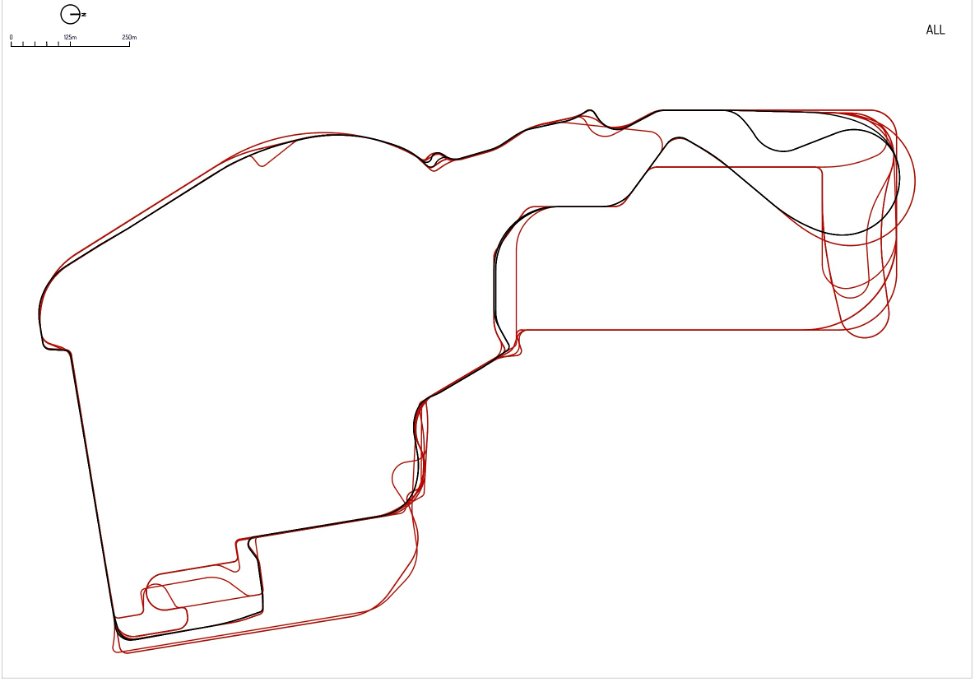
The Madrid project passed through numerous materially different configurations. The comparison distinguishes the early conceptual work from the later project development without suggesting that continuity of site or ambition made the final geometry automatic.

Topography / Valdebebas
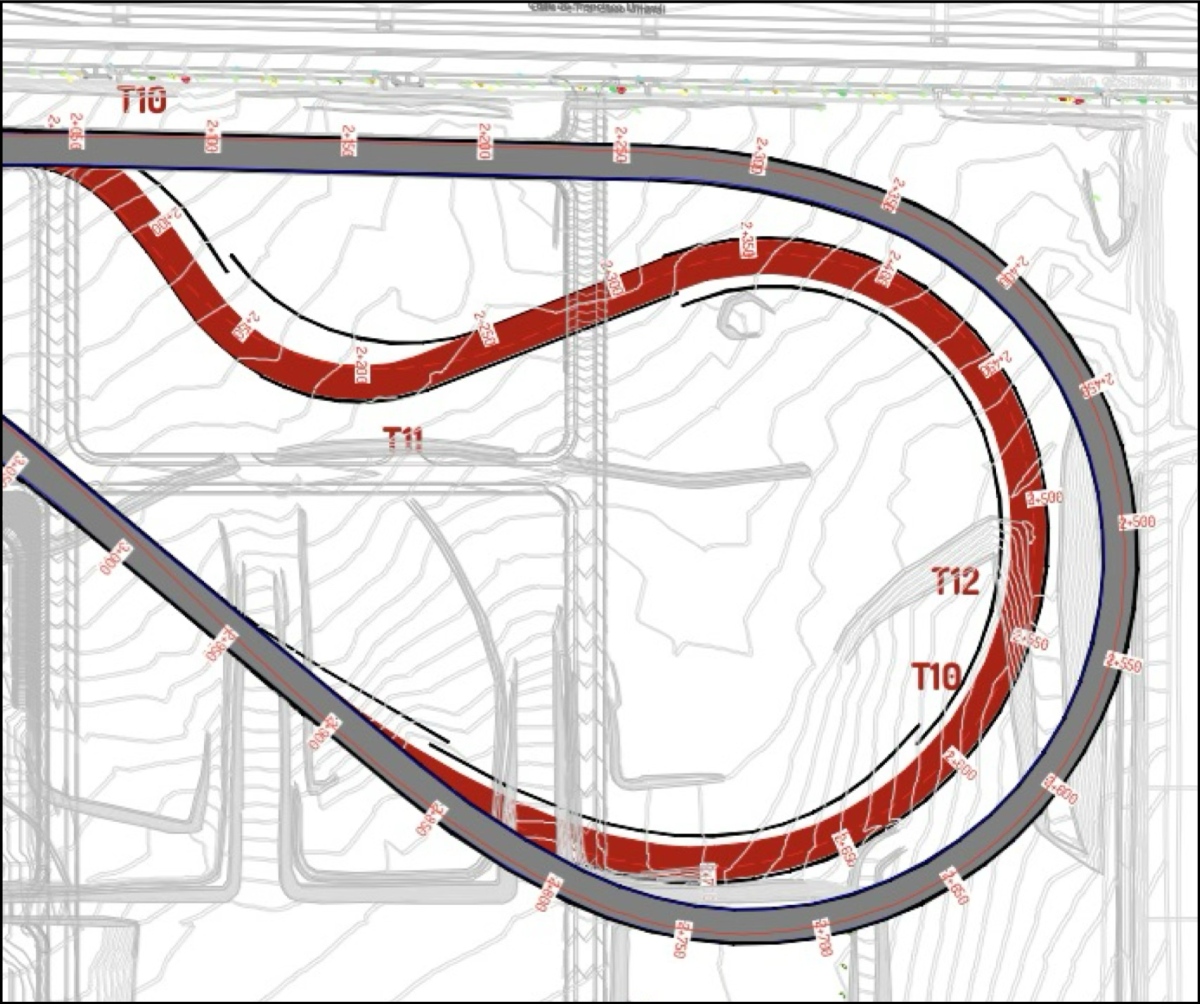
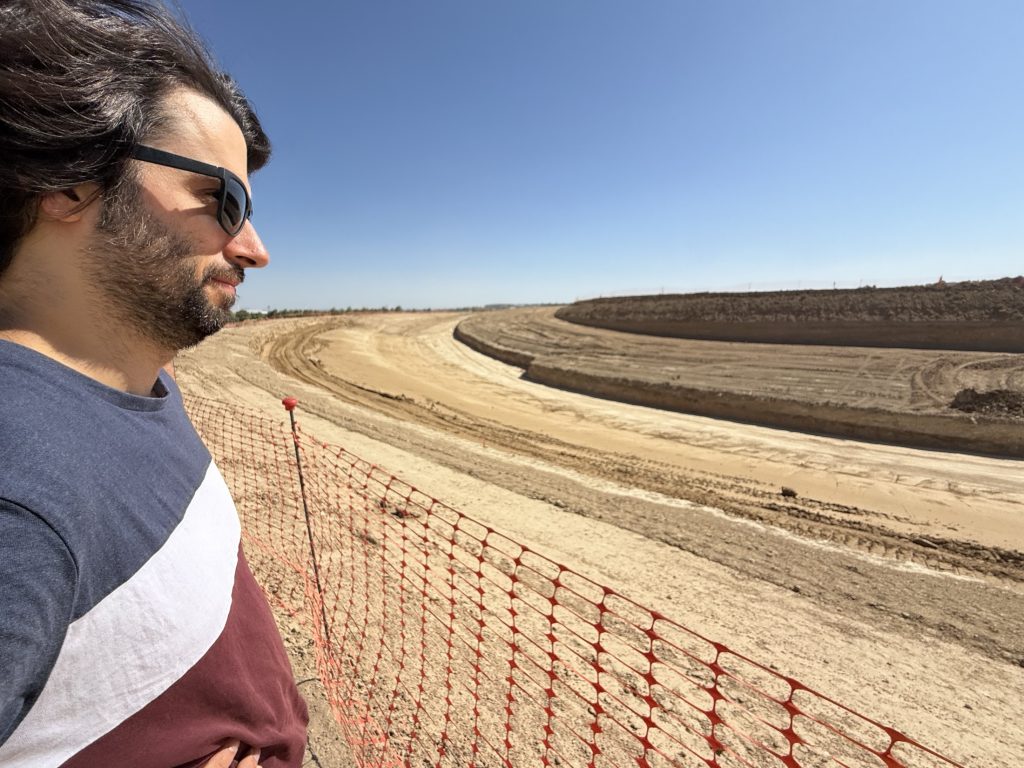
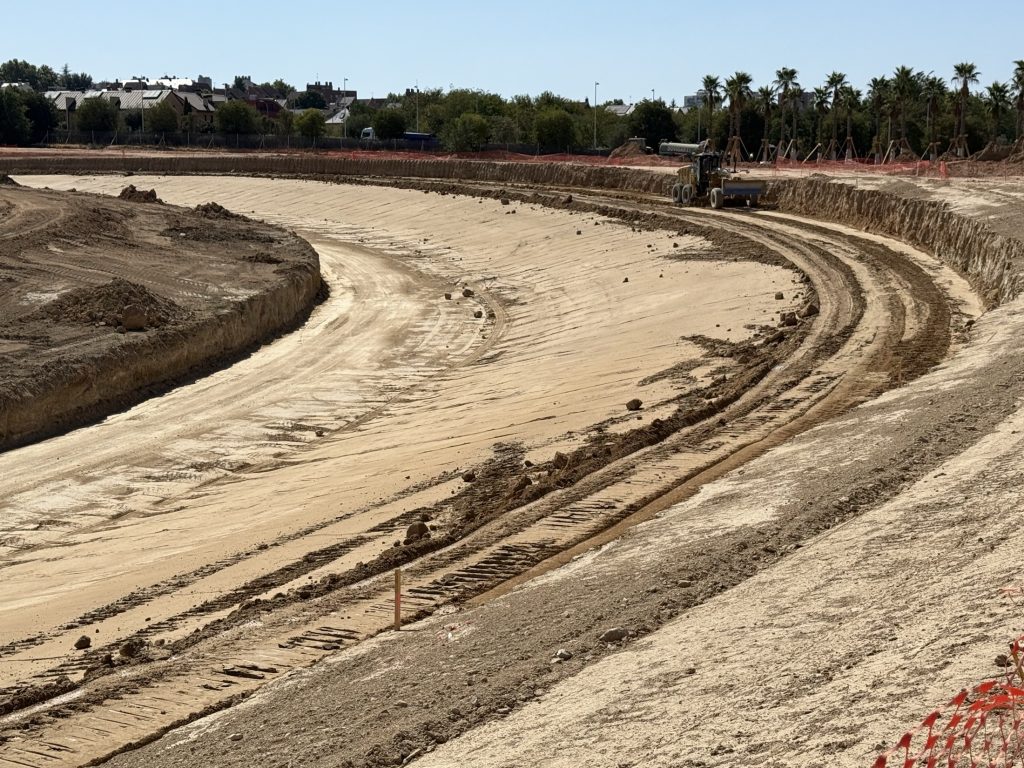
From the upper roundabout near the fort, the circuit descends along the escarpment through a substantial level change of approximately 12–13 metres. The earliest approach followed the existing slope more directly and entered a very fast, highly banked curve as a virtual continuation of the preceding straight.
That concept was viable, but it was not fixed. The site also allowed the entry to move upstream, the rotation to begin earlier, the speed-reduction sequence to become more pronounced, or the line to move by different amounts within the available envelope.
Each alternative would have changed the rhythm of the lap, entry commitment, minimum speed, run-off demand, acoustic position, spectator reading and the relationship with the following braking zone.
Public view / @_dronearte
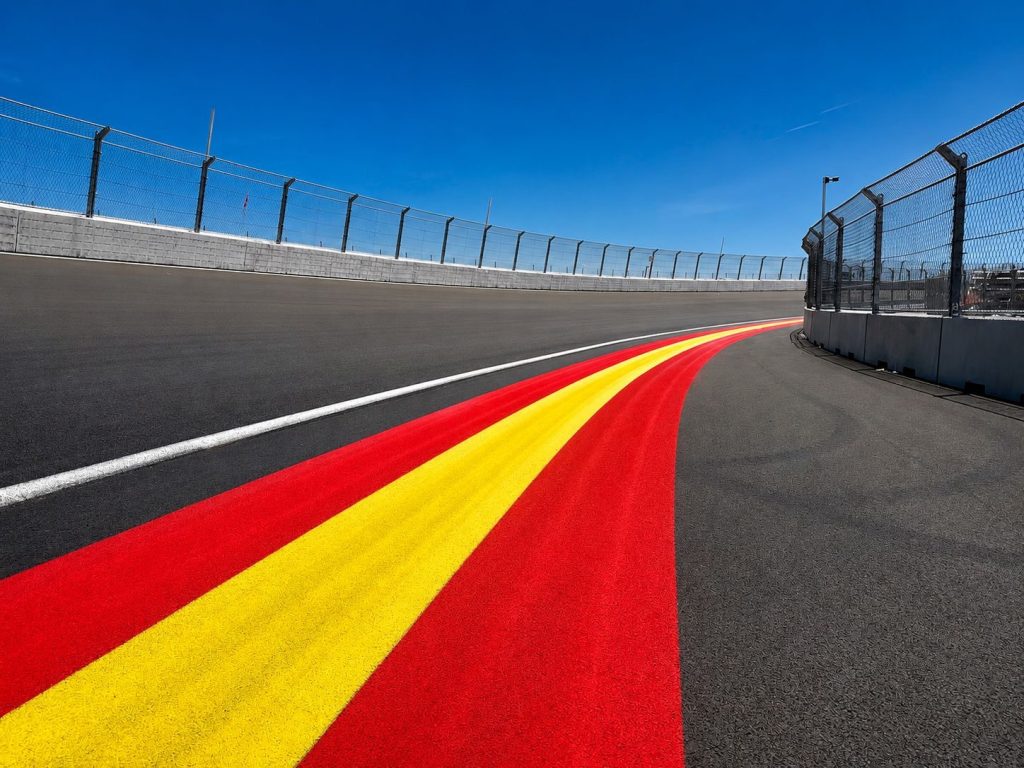
This aerial reel by @_dronearte shows La Monumental within the wider Valdebebas site. From this height, the scale and relationship with the surrounding infrastructure are immediate. What is less visible is the section’s full three-dimensional behaviour: the changes in level, the descent and rise, the entry crossfall and the progression into positive banking.
That difference between an overview and the on-track experience is precisely why a circuit cannot be understood from its plan outline alone.
Video credit: @_dronearte / Instagram. View the original post ↗ · Read Dromo’s response ↗
La Monumental / Version 16.03
The sequence was revised to control the approach condition without sacrificing the identity of the banked corner or the major braking opportunity immediately after it.

An earlier directional change and inward relocation altered how the car arrived at the banked section.
The descent, later rise and strong compression at entry turned topography into part of the driving sequence.
The chosen geometry preserved the high-value braking event into the corner following La Monumental.
Design feedback
Feedback can identify a performance target—such as reducing the speed at entry to a banked corner—without generating the geometry that achieves it. A tighter radius, an earlier turn-in, a different directional change or a more obvious slowing device may all address the same target while producing materially different circuits.
Dromo evaluated those consequences together. Some options were rejected because they weakened driving quality, the internal logic of the sequence or the relationship between La Monumental and the braking zone that follows.
The existence of technical and safety requirements does not remove creativity. It makes the quality of the designer’s interpretation decisive.
From centreline to authored surface
Dromo developed the later project phases on a new high-precision survey basis acquired from March 2024 using LiDAR scanning, UAV photogrammetry and GNSS measurements.


Approach attitude, radii, transitions, apex position and the relationship between consecutive elements.
Descent, rise, compression and elevation are coordinated with speed and driver perception.
The entry moves from adverse crossfall into positive banking through authored compound transitions.
Racing line, shoulders, run-off, drainage and surrounding ground must operate as one buildable system.
Construction translation
The cross-sections, profiles and setting-out information used during delivery are outputs of the authored surface. The governing design act came earlier: deciding how the car should approach, rotate and exit; how the banking should develop; where compression should be felt; and how the sequence should prepare the next part of the lap.
During the first six months of construction, Dromo followed the translation of this intent into earthworks, formation, levels, banking and paved geometry.


Authorship
La Monumental was created through the coordinated design judgement of Jarno Zaffelli, Francesco Grana and Federico Vennarucci, working through Dromo’s circuit-design and three-dimensional engineering process.
Co-author · design principal and overall project design judgement.
Co-author · circuit design development and interpretation of performance and safety constraints.
Co-author · high-precision survey basis, three-dimensional engineering design and construction translation.
Connected Dromo knowledge
Dromo Circuit Design
Explore how Dromo connected circuit identity, three-dimensional geometry and construction delivery at MADRING.
Explore the MADRING projectAll images remain the property of their respective rights holders and are published under the applicable licence or permission.
Dromo Design, Architecture and Landscape ©2026 IT02756420358
Our site uses cookies. Learn more about our use of cookies: cookie policy